
Kim Davis, the Ill-Served Client
Attorney Responsibility For the Mess She's In

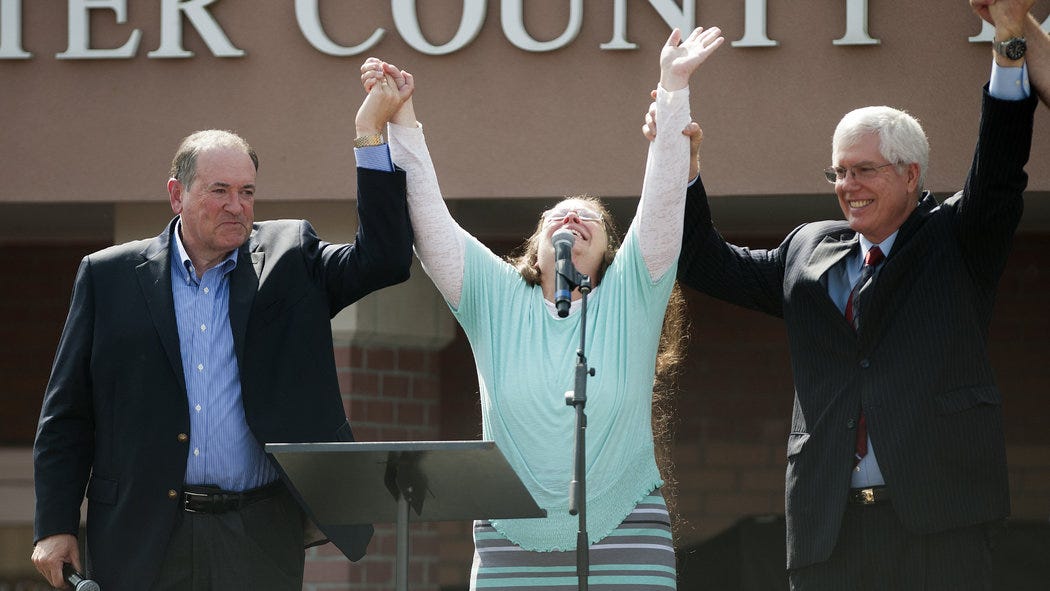
Kim Davis is in the news for being sued, again. A new lawsuit, by one of the couples to whom she owes extensive fees and damages, may have merit or it may not, but I think it raises an important issue about the responsibility of lawyers to their clients, especially when those clients’ cases may be used as a vehicle to further the lawyers’ larger legal or political goals.
There is a lot of background to this story, so bear with me.
In the summer of 2015, I, along with three other attorneys, sued Davis, the former clerk of Rowan County, Kentucky.1 If you recall, she infamously refused to issue marriage licenses as a personal protest against Obergefell v. Hodges, which had come down that June. Kentucky state law at the time required county clerks to sign completed marriage licenses, but Davis felt that she could no longer do that because of her sincerely held religious belief that gay people should not be treated equally by the government. So when people began showing up to her office seeking marriage licenses, she refused to issue them to anyone. By doing so, she violated the civil rights of all who were otherwise qualified to receive a license, whether gay or straight. Four couples, led by April Miller and Karen Roberts, contacted our office and the ACLU of Kentucky to see what could be done. We (three private lawyers and one from the ACLU) then sued Kim Davis for preliminary and permanent injunctions that would force her to resume issuing licenses. Our case was called Miller v. Davis.2
Eight days later, another couple, David Ermold and David Moore, represented by different counsel, sued Davis as well. Videos had circulated widely of Ermold and Moore approaching the counter at the clerk’s office only to be refused service by Davis herself. Ermold and Moore did not just sue for an injunction, however. They sued Davis for damages. Their case was called Ermold v. Davis.3
Over the course of the next several weeks, multiple filings were filed and multiple hearings were held across multiple cases. In early August, the court granted our preliminary injunction motion. But Davis refused to comply with that injunction, so another hearing was held, and Davis ended up being jailed for contempt when she told the court—on the stand—that she would not issue marriage licenses despite the injunction.4 With her in jail, the clerk’s office began issuing licenses again, including to our clients. Victory!
Davis was shortly released, and then appealed the injunction and the contempt order, which stalled closure for everyone. Eventually, in the spring of 2016, the Kentucky General Assembly passed a bill to relieve county clerks of the obligation to sign marriage licenses. That mooted Davis’s appeals in our case and effectively ended Miller v. Davis. A year later, the trial court ended up awarding our team nearly a quarter of a million dollars in attorney fees for our success, which Kentucky eventually paid.5
But the fun was not over for Davis. Ermold and Moore’s case persisted, because they sought more than just an injunction. They sought damages, which necessitated a trial if Davis refused to settle with them. Sure enough, no settlement was reached, and they had a jury trial in federal court in September 2023, eight years after the initial lawsuit. The court ruled that Ermold and Moore were entitled to summary judgment on liability and the jury subsequently awarded them each $50,000 in damages.
However, three years since the plaintiffs’ big win at trial, Ermold v. Davis is still not really over. After Davis lost in 2023, she appealed to the Sixth Circuit, which ruled against her in early 2025. And, despite media speculation that they might take up her case to somehow unravel Obergefell, the Supreme Court denied certiorari in November of that year.
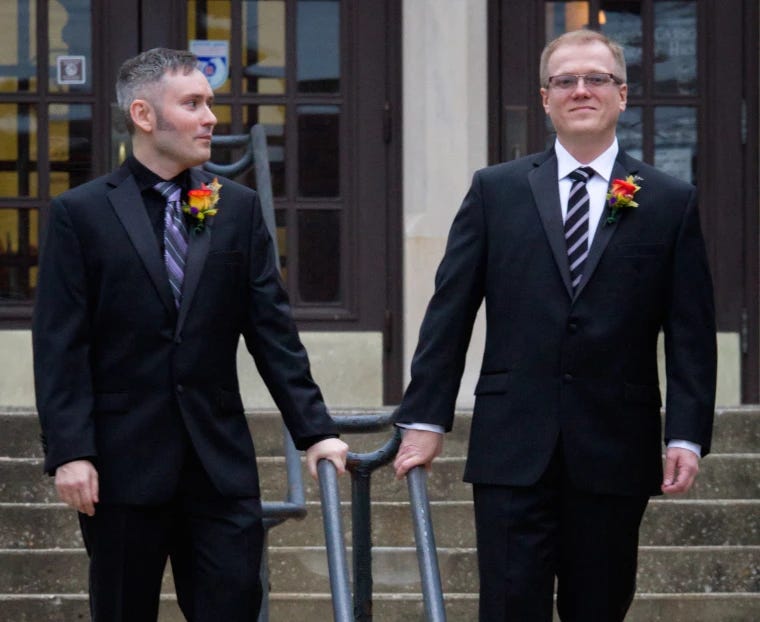
But Davis still has not paid Ermold or Moore anything, and now they are suing her again, alleging that she is deliberately hiding extensive assets in order to avoid what is now more than half a million dollars in damages and attorney fees. $565,285.91, to be precise.
Wait, you might be thinking, why on earth was the trial held eight years after the initial lawsuit, and how on earth does she owe that much now? Well, both are because Kim Davis’s lawyers very aggressively litigated her case. In both our case and Ermold’s, they filed motions to dismiss. They filed their own motions for injunctions. They sued then-governor Steve Beshear. They filed emergency motions for stays. They appealed the denial of their motions for stays. They argued Davis was entitled to qualified immunity. They appealed the denial of qualified immunity. They appealed nearly every order by the trial court, no matter how mundane. They appealed her contempt order. They appealed the preliminary injunction order. They appealed our fee award. And, for all that effort, the district court and the Sixth Circuit ruled against them repeatedly, and the Supreme Court denied certiorari twice. But Davis’s attorneys persisted in contesting everything, often making the same arguments that had been rejected before in briefs that appeared to be cut-and-pasted from previous briefs. On and on and on.
So, over the span of thirteen years of loss after loss after loss, Davis’s attorneys have exposed her to over half a million dollars of liability for attorney fees and damages. Regardless of whether there is any merit to the new lawsuit against her, that liability will follow her forever until it is paid off. And, nearly all of it was probably avoidable.
Kim Davis’s legal arguments were always going to lose. Our constitution’s promises of due process and equal protection cannot tolerate local elected officials deciding for themselves—based on their own beliefs, religious or otherwise—who they will serve or what services they will provide. Local elected officials cannot become laws unto themselves, no matter how sincere their beliefs or how stark the conflict of their conscience. They must either do their jobs, resign, or be enjoined and held liable. Those were always Davis’s only options.
And yet, for more than a decade, her attorneys, part of an activist group of religious conservatives, pressed on regardless, dragging out her case through their relentless and repetitive motions and appeals (all or nearly all of which were unsuccessful).
In 2025, for example, a decade after the lawsuits against Davis were initially filed, the Sixth Circuit noted that they had already rejected her qualified immunity arguments twice before, then rejected them a third time in an opinion that reads like a long, exasperated sigh. Later in the same opinion, the Sixth Circuit observed that not only were Davis’s legal arguments “novel,” but they also “fail[ed] under basic constitutional principles,” “conflate[d] two legal concepts and [were] incorrect,” or were otherwise “irrelevant” to the case, not to mention that it was no surprise that Davis had “not found a case” to support any of them. Davis’s arguments, the court even said, “would subvert the Bill of Rights,” and therefore “cannot be correct.”6
Kim Davis’s arguments were so wrong, the Sixth Circuit felt them worth extrapolating for illustration:
Indeed, it is not difficult to imagine the dire possibilities that might follow if Davis’s argument were accepted. A county clerk who finds interracial marriage sinful could refuse to issue licenses to interracial couples. An election official who believes women should not vote could refuse to count ballots cast by females. A zoning official personally opposed to Christianity could refuse to permit the construction of a church. All these officials would have wielded state power to violate constitutional rights—but they would have followed their conscience, which Davis believes provides a “defense to liability.”
That is not how the Constitution works.
While the Sixth Circuit did not outright say that any of Davis’s arguments were frivolous, they came pretty close.
If I were Davis’s attorney, and I had (1) her interests in mind, and (2) any constitutional expertise at all, I would have advised Kim Davis that she was bound to lose in court, even if I wished that wasn’t the case or felt that the underlying law was wrong. And because she was bound to lose, I would have advised her that her best options were to immediately rescind her unconstitutional policy or resign as a matter of principle. Instead, Davis’s attorneys vigorously defended her all the way to half a million dollars of “crippling” personal liability, none of which they are apparently willing to indemnify.7
If a criminal defense case looks bad, competent attorneys will recommend a plea deal. When a civil defense case looks bad, competent attorneys will recommend that their clients settle.8 But that is assuming that those attorneys have put their clients’ interests first, as the rules of practice compel.9 Though there is often room for attorneys to use clients’ cases to pursue changes in the law, attorneys must nevertheless be honest with their clients about the risks of doing so. If the attorney is negligently blind to those risks, they are not fulfilling their duty of competence. If the attorney is intentionally blind to those risks, they may have a conflict of interest (such as a personal political motivation) that interferes with their ability to represent their client fairly and responsibly. In that case, they should withdraw from representation.
In your capacity as an attorney, your job is to represent your clients, to advocate for them, to counsel them, and to look out for them. Your personal views may align with their legal cause, but that is neither necessary nor what should be the driving force behind your professional choices as their attorney. The client’s interests matter the most, and sometimes, their interests may necessitate a change in strategy or even an admission of defeat. Your larger political cause may have to wait for a better case, a better client, or a better day.10
In past interviews and presentations, I have publicly stated that I feel Kim Davis’s attorneys have done her a significant disservice, but that assumes they have been in control. Perhaps she has been driving the bus the entire time, forcing them to drag out her case for more than a decade when it could have been resolved long ago, and at far less cost to her. Considering who her attorneys are, though, I highly doubt it. Even if she has shared responsibility for the whole failed campaign to make America more theocratic and less equal, it is hard to conclude (from the stack of adverse rulings and liability in front of her) that she has had the benefit of unconflicted representation along the way. That would be a shame not only for her and those to whom she now owes a considerable amount of money, but also a shame for our profession.
The first syllable in Rowan rhymes with “ow.” The formal pronunciation is: ˈɹaʊ.ən. It does not sound like ROE-wan.
Attorneys from the national office of the ACLU later joined us to assist with briefing.
A third suit, Yates v. Davis, also sought damages.
Just for the record, the court ordered her jailed sua sponte—we, as plaintiffs, did not ask for that specific remedy and frankly thought it would create a media circus, which it did, not to mention make her seem like a culture war martyr instead of a government official who had abused her power.
If you successfully sue a state official for violating your federal constitutional rights, you are entitled to attorney fees, which means the losing side has to pay your lawyers for the work they did vindicating your rights. Unfortunately, actually getting paid can take some time. We filed our lawsuit in June 2015, had won by September, and were awarded fees in July 2017, but Davis appealed. We were not actually paid until November 2019. Worse, had we filed the same fee motion today, it would have been denied, because the U.S. Supreme Court has changed the law on when plaintiffs are entitled to attorney fees in civil rights cases. Even though we preliminarily enjoined Davis and got the licenses we sought, the legislature’s later intervention obviated us from getting a permanent injunction, and therefore we would not have “prevailed” sufficiently to have earned fees. Just in case being a plaintiff-side civil rights attorney wasn’t already hard enough…
Emphasis added. This is not how any self-respecting attorney wants their arguments to be described by a court, by the way.
When Davis was sued in 2015, the organization that provided her legal defense had annual revenue of over $5 million, according to their last publicly available tax information.
When plaintiff-side civil rights attorneys sue, they do it on contingency so that their client does not have to pay for anything (other than litigation costs at most). If April Miller and Karen Roberts had lost, they would have had to pay nothing to us or to anyone else.
See Ky. Supreme Court Rule 3.130(3.2): “A lawyer shall make reasonable efforts to expedite litigation consistent with the interests of the client.”
For example, I highly doubt that it would be a good idea, today, to pursue the cases that eventually became Obergefell.